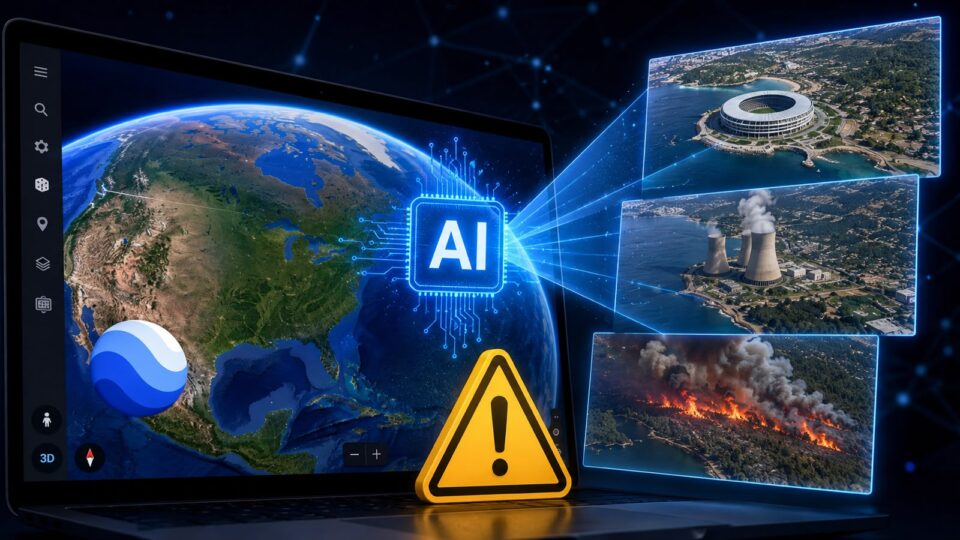
Google temporarily withdrew its new AI-powered Google Earth image-generation feature after users created misleading satellite images, prompting the company to strengthen safeguards against misinformation.
WEBDESK – ABDULLAH FARHAD – SHARJAH NEWS
Google Pauses Newly Launched AI Feature
Google has temporarily withdrawn a newly launched artificial intelligence (AI) image-generation feature in Google Earth after widespread concerns over its potential misuse. The feature, introduced as part of Google’s latest AI capabilities, allowed users to generate realistic images of real-world locations using simple text prompts. Although the tool was intended to help professionals visualize locations and create illustrative content, it was removed less than 24 hours after launch when users began sharing misleading AI-generated satellite images online.
The decision highlights the growing challenge technology companies face in balancing AI innovation with the need to prevent misinformation and abuse.
What the Feature Could Do?
The new tool was powered by Google’s “Nano Banana 2” AI model. It enabled users to type prompts such as adding buildings, changing landscapes, or creating hypothetical scenes, which were then overlaid onto Google Earth’s satellite and 3D imagery.
Google designed the feature for educational, planning, and creative purposes. Geospatial professionals, researchers, and urban planners were among those expected to benefit from the technology by producing conceptual visualizations without altering Google’s actual mapping data.
Importantly, the AI-generated images were separate from Google Earth’s official imagery and included digital watermarks indicating they had been created using AI.
Why Google Removed It?
Shortly after the feature became available, users demonstrated that it could be used to create convincing fake satellite images of real locations.
Examples shared online included fabricated disaster zones, fictional military facilities, altered conflict areas, and other misleading scenes. Although these images were not displayed in Google Earth’s public map database, experts warned that screenshots could easily circulate on social media without context, making them appear authentic.
Open-source intelligence (OSINT) researchers and digital verification experts expressed concern that manipulated satellite imagery from a trusted platform could make it more difficult to distinguish genuine evidence from fabricated content during wars, natural disasters, or breaking news events.
Following these concerns, Google decided to pause the feature while it develops stronger safeguards.
Google’s Official Response
In a statement, Google acknowledged that while many professionals had found constructive uses for the feature, it had also observed generated images that appeared to violate company policies.
The company emphasized that users place a high level of trust in Google Earth as a reliable representation of the real world. Because of that trust, Google said it would temporarily disable the feature while improving its safety protections and moderation systems before considering a future relaunch.
Google has not announced a timeline for when the feature may return.
Why the Story Matters
The incident illustrates one of the biggest challenges facing generative AI: preventing realistic synthetic content from being used to spread misinformation.
Satellite imagery has become an important source of evidence for journalists, emergency responders, governments, and independent investigators. If AI-generated images become indistinguishable from authentic satellite photographs, they could complicate fact-checking efforts and undermine public trust in visual evidence.
Experts say watermarks alone may not stop misleading images from spreading, especially when screenshots are reposted across social media platforms without their original context.
Broader AI Safety Debate
Google’s decision follows similar actions by other major technology companies that have withdrawn or modified AI features after unexpected misuse.
The rapid removal of the Google Earth tool demonstrates how quickly companies are responding when new AI products create unforeseen risks. Industry analysts believe future AI image-generation systems will require stronger verification methods, clearer labeling, and more effective safeguards before they are widely deployed.
Google’s temporary withdrawal of its AI image-generation feature from Google Earth is not a cancellation of the technology but a precautionary measure. The company says the feature showed genuine value for professional users but also revealed significant risks when used to create misleading imagery.
As generative AI becomes increasingly powerful, technology companies face growing pressure to ensure their products are innovative while also protecting users from misinformation and preserving trust in widely used digital platforms. Google has stated it will continue working on stronger safeguards before deciding whether to reintroduce the feature.