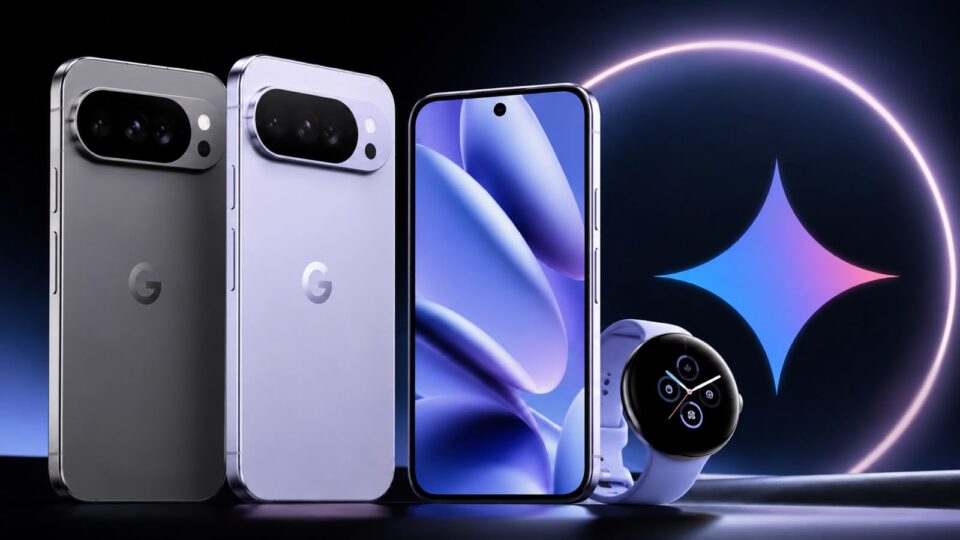
Google’s Pixel 11 introduces Gemini-powered tools for smarter voice typing, photography, notifications and accessibility, aiming to make smartphones more useful while helping users stay present.
WEBDESK – ABDULLAH FARHAD – NJNEWSLINE
Google Puts Gemini Intelligence at the Center of Pixel 11
Google has unveiled its new Pixel 11 smartphone family, placing artificial intelligence at the heart of the company’s latest hardware strategy. The Pixel 11, Pixel 11 Pro and Pixel 11 Pro XL are powered by Google’s new Tensor G6 processor and introduce a collection of AI-driven features designed not simply to add more functions, but to reduce the amount of time users spend interacting with their screens.
Google’s approach reflects a broader shift toward what it calls “Gemini Intelligence,” with the company attempting to make smartphones more proactive, context-aware and useful in everyday situations.
Rambler Turns Natural Speech Into Polished Writing
One of the most notable features is Rambler, an AI-powered voice-input experience integrated into Gboard. Instead of requiring users to dictate perfectly formed sentences, Rambler is designed to understand natural speech, including pauses, corrections and filler words, before producing a cleaner written version.
Google previously introduced Rambler as part of its Gemini Intelligence strategy for Android. The company says the feature can also understand multilingual conversations, allowing users to switch between languages while speaking.
That could make voice input particularly useful for emails, messages, documents and other everyday writing where conventional speech-to-text often requires substantial editing.
Magic Capture Focuses on the Moment
Google is also introducing Magic Capture, a camera feature designed to help users capture memorable moments without constantly concentrating on taking photographs.
The technology can work while an event is being recorded and use AI to identify strong photographic moments, potentially allowing users to participate in experiences rather than repeatedly checking their phone camera. Independent reporting describes the feature as combining video recording with automated selection of high-quality still images.
The feature fits directly into Google’s stated goal of making technology less intrusive while preserving important memories.
HiLight Brings Notifications Without the Screen
Pixel 11 Pro and Pixel 11 Pro XL introduce another unusual idea: HiLight, an LED glow built around the camera flash.
When the phone is placed face down, the system can provide visual alerts for calls from selected important contacts without requiring users to turn the phone over and look at the display. Google says the feature is intended to help people remain connected without becoming distracted by conventional screen notifications.
The same technology is also included on the Pixel 11 Pro Fold, where Google says color-coded illumination can indicate calls from favorite contacts and other future notifications.
Sign-to-Text Could Be the Most Meaningful Upgrade
Perhaps the most significant development is Google’s new sign-language-to-text technology for accessibility.
The system brings sign-to-text capabilities to Gboard and Live Transcribe, initially supporting American Sign Language and English. It is designed to allow people who use ASL to communicate with their phones through signing rather than typing, including composing messages and interacting with digital services.
Google has emphasized that the technology was developed with involvement from the Deaf community, representing an important attempt to apply generative and multimodal AI to accessibility rather than entertainment alone.
Pixel 11 Arrives With Major Hardware Upgrades
Beyond AI, Google has upgraded the underlying hardware. The Pixel 11 features a larger 48-megapixel main sensor, while the Pro models receive improved cameras and up to 120x Pro Zoom. The Tensor G6 also delivers faster processing and more efficient on-device AI.
Google has priced the Pixel 11 starting at $899, Pixel 11 Pro at $1,099, and Pixel 11 Pro XL at $1,299. The phones are scheduled to become widely available on August 20.
With Pixel 11, Google is betting that the future of smartphones is not simply about adding more technology, but making that technology work quietly in the background—potentially giving users more time to focus on life beyond the screen.