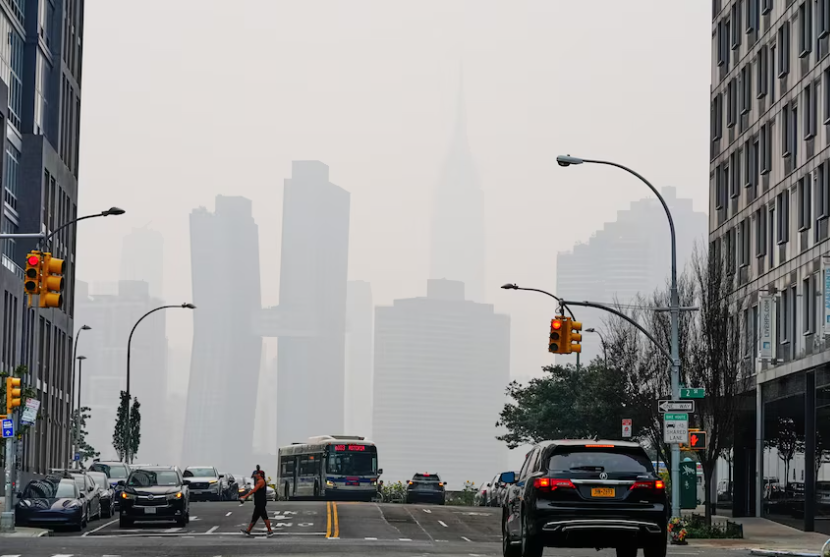
Smoke from hundreds of Canadian wildfires spread across the United States, triggering health alerts, hazardous air quality, school precautions, and renewed concerns about climate change impacts.
WEBDESK – SHARJAH NEWS
Heavy smoke from hundreds of wildfires burning across Canada has spread deep into the United States, shrouding major cities from the Great Lakes to the Northeast and prompting officials to urge millions of residents to stay indoors or wear protective masks.
The smoke, generated by hundreds of active wildfires in Canada and several fires in northern Minnesota, has created hazardous air quality across large parts of the Midwest and eastern United States, reducing visibility and raising serious public health concerns.
Detroit recorded the world’s worst air quality on Thursday, according to air monitoring company IQAir, with a pollution index of 600—twice the level classified as “hazardous” by the U.S. Environmental Protection Agency (EPA).
Federal monitoring data showed dangerous smoke concentrations across Minnesota, Michigan, northern Illinois, northern Ohio, and parts of Ontario. Major cities, including Minneapolis, Milwaukee, and Toronto, also reported hazardous air quality, while at least 10 U.S. states recorded “unhealthy” conditions extending as far south as Maryland.
In New York City, thick smoke turned the sky orange and yellow, with iconic landmarks such as the Statue of Liberty and the Manhattan skyline barely visible through the haze.
New York City Mayor Zohran Mamdani warned residents that the day was expected to bring the worst air quality of the event, stressing that the health risks extended beyond vulnerable groups.
“At unhealthy levels, everyone—not just people with asthma or heart conditions, not just older adults—everyone may feel health effects,” the mayor said while announcing the distribution of free KN95 face masks at libraries, police precincts, and fire stations across the city.
Residents described immediate health effects as the smoke lingered over urban areas. Gwen Moseley, a therapist from Queens, said she picked up a free mask before heading to work and noticed throat irritation while walking outdoors.
In Chicago, 76-year-old Bill Ostrowski wore a face mask while walking through downtown streets blanketed by smoke.
“It stinks. It’s not a good sign when you wake up in the morning, and you can smell the air,” he said.
Canadian authorities reported 858 active wildfires on Thursday morning, including 111 classified as out of control. Most of the blazes are burning in the provinces of Manitoba, Saskatchewan, and Ontario, where prolonged hot and dry conditions have fuelled rapid fire growth.
Scientists say the smoke plume is being carried south by prevailing weather patterns, creating what experts describe as a continuous stream of polluted air flowing into the United States.
“It’s basically a river of smoke pouring into the Midwest right now,” said Emily Fischer, an atmospheric chemist at Colorado State University.
She added that increasingly severe wildfire seasons are closely linked to climate change, warning that prolonged exposure to wildfire smoke poses growing health risks for millions of people across North America.
Public health officials continue to advise residents to limit outdoor activities, keep windows closed, use air filtration where possible, and wear high-quality masks if they must spend time outside until air quality improves.