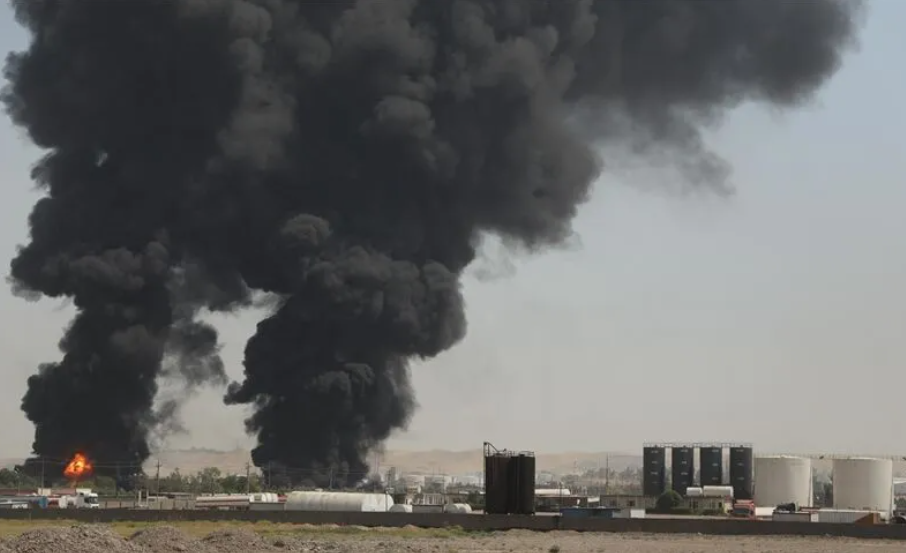
Iran launched missile and drone attacks on Qatar, Kuwait, and Bahrain after another night of U.S. strikes, escalating Gulf tensions and raising fresh concerns over regional security and energy markets.
WEBDESK – SHARJAH NEWS
SHARJAH: The Middle East moved closer to a broader regional conflict on Friday after Iran launched missile and drone attacks targeting Qatar, Kuwait, and Bahrain in retaliation for a sixth consecutive night of U.S. military strikes inside Iran, bringing Gulf states hosting American military facilities directly into the expanding confrontation.
The latest escalation has heightened security concerns across the Gulf, with fears growing over the safety of commercial shipping, global energy supplies, and the stability of the Strait of Hormuz, one of the world’s busiest maritime corridors.
Iranian state media said the attacks were carried out in response to overnight U.S. airstrikes that targeted airports, railway stations, bridges, and other strategic infrastructure. Iranian officials said at least seven people were killed during strikes on the southern port city of Bandar Khamir.
Qatar confirmed that its air defence systems successfully intercepted Iranian missiles before they reached their intended targets. Authorities said a child was injured by shrapnel during the interception and was receiving medical treatment.
Kuwait said it was responding to missile and drone attacks aimed at U.S. military installations within the country, while Bahrain activated air raid sirens and urged residents to take shelter as a precaution.
The attacks marked one of the most serious direct threats faced by Gulf states since the conflict between Washington and Tehran sharply intensified this week.
According to the U.S. Central Command (CENTCOM), American fighter aircraft, drones, and naval forces carried out extensive overnight strikes against dozens of Iranian military targets for the sixth consecutive night. The operations reportedly targeted coastal surveillance systems, air defence sites, logistics hubs, and maritime capabilities.
Iranian media reported that U.S. strikes also damaged five bridges in Hormozgan province, including key transport links serving Bandar Abbas. The official IRNA news agency, citing Hormozgan University of Medical Sciences, said seven people were killed after bridges in Bandar Khamir were hit.
Mehr News Agency also reported that a U.S. missile struck the maritime control tower in Chabahar for the third time this week, underscoring the sustained campaign against Iran’s coastal infrastructure.
The deteriorating security situation is increasingly affecting maritime traffic through the Strait of Hormuz, a strategic waterway through which nearly 20% of globally traded oil passes.
CENTCOM said U.S. forces redirected three vessels operating in the strait, boarded one tanker, and disabled another vessel that allegedly failed to comply with American maritime restrictions. The U.S. military said commercial shipping remained open, except for vessels that violated what it described as its maritime security measures.
The conflict is also beginning to disrupt regional energy operations. UAE-based energy producer Dana Gas suspended production at one of its Iraqi gasfields because of security concerns, while India instructed its seafarers to avoid transiting the Strait of Hormuz until conditions improve.
Diplomatic efforts have also been affected. Israeli Prime Minister Benjamin Netanyahu postponed a planned visit to Washington next week as regional security conditions continued to deteriorate.
Meanwhile, an armed group calling itself the Islamic Resistance in Iraq reportedly announced a reward for anyone who kills U.S. President Donald Trump, further raising concerns that the conflict could expand beyond conventional military exchanges.
For Gulf countries, including the UAE, the rapidly evolving security environment presents growing economic and strategic challenges. Any prolonged disruption to shipping through the Strait of Hormuz could affect regional trade, increase energy prices, and complicate efforts by Gulf states to maintain stability amid one of the most dangerous military confrontations in the Middle East in recent years.