

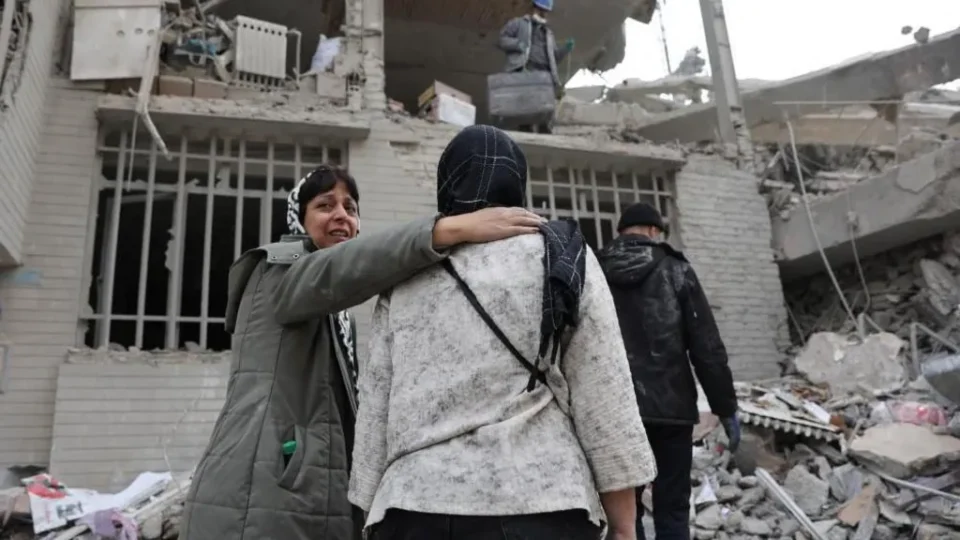
As air strikes hit Iranian cities, civilians fear the conflict could devastate infrastructure and livelihoods while failing to bring the political change many once hoped for.
WEBDESK – Source: The National
As the war involving Iran, the United States, and Israel enters its third week, ordinary Iranians say the conflict is pushing the country into deeper fear, uncertainty, and despair, with many believing the biggest victims will be civilians rather than political leaders.
Residents in Tehran and other major cities say the constant air strikes, rising civilian casualties, and widespread displacement have left the population exhausted and traumatised. While governments involved in the conflict continue to pursue military objectives, many Iranians say they see no clear end to the war.
“People’s depression has become much worse,” said a Tehran resident identified as Sina, speaking anonymously for security reasons. “There was once hope that things might change for the better. Now it feels like life has only become harder.”
Civilians trapped in a war with no clear outcome
According to the United Nations, more than 3.2 million people inside Iran have been displaced since the war began. Tens of thousands have fled Tehran as bombing intensifies in and around the capital.
Residents say the strikes often occur near residential areas because military and security installations are located among civilian neighborhoods.
“The explosions are terrifying,” said Arezoo, another Tehran resident. “The blasts are so loud that people cannot sleep at night. Civilians are being killed, and people are scared the attacks could happen anywhere.”
Human rights groups estimate the death toll has climbed above 1,800 people, including more than 1,200 civilians, though the exact figures remain disputed.
Among the victims were children and families caught near military targets. In one reported incident, a missile strike near a school in southern Iran killed dozens, including young students.
War changing public opinion
Some Iranians who initially believed foreign intervention might weaken the Islamic Republic say they are now reconsidering their views.
“Some people who supported attacks at the beginning are now regretting it,” Sina said. “When bombs are falling, people begin to prioritise security over political change.”
Others fear the war may leave the country devastated while the political system remains intact, possibly empowering even harder-line leadership.
Fears of stronger hardliners
Analysts say the conflict may strengthen Iran’s most hardline political factions rather than weaken them.
With the backing of powerful security forces such as the Islamic Revolutionary Guard Corps (IRGC), many fear Iran’s leadership could become even more authoritarian after the war.
Some residents worry the destruction of infrastructure, worsening economic conditions and political repression could push the country toward deeper instability.
“The country could end up poorer, more isolated and more authoritarian,” said Arezoo. “That’s what many people are afraid of.”
Heavy security blocks protests
Despite calls from outside Iran for citizens to rise against the government, large-scale protests have not emerged during the war.
Security forces have increased their presence across cities, deploying paramilitary units and establishing checkpoints where phones and vehicles are searched.
Authorities have also imposed internet blackouts, limiting communication and access to independent news sources.
Police chief Ahmadreza Radan warned that anyone cooperating with foreign media or “acting at the enemy’s behest” would be treated as an enemy of the state.
Human rights groups say at least 195 people have already been arrested during the conflict on accusations ranging from social media activity to alleged espionage.
Ordinary Iranians fear they will be the real losers
Many residents believe that regardless of who claims victory, the Iranian population will ultimately bear the cost of the war.
“If the war ends in a few months, both sides will say they won,” said Sina. “But the real losers will be the people of Iran.”
For many citizens already struggling with sanctions, inflation, and economic hardship before the conflict, the prospect of rebuilding destroyed infrastructure and military capabilities raises fears of an even more difficult future.
As the bombing continues and political tensions deepen, ordinary Iranians say their greatest fear is not just the war itself — but what their country may become after it ends.
